Growth Rate and Adult Height: Different Outcomes in a Study
First-year growth velocity and near-adult height are different endpoints. One describes change over an early interval; the other describes height attained later under a study’s definition. A stronger early rate cannot simply be multiplied by the remaining childhood years to produce a final-height claim.
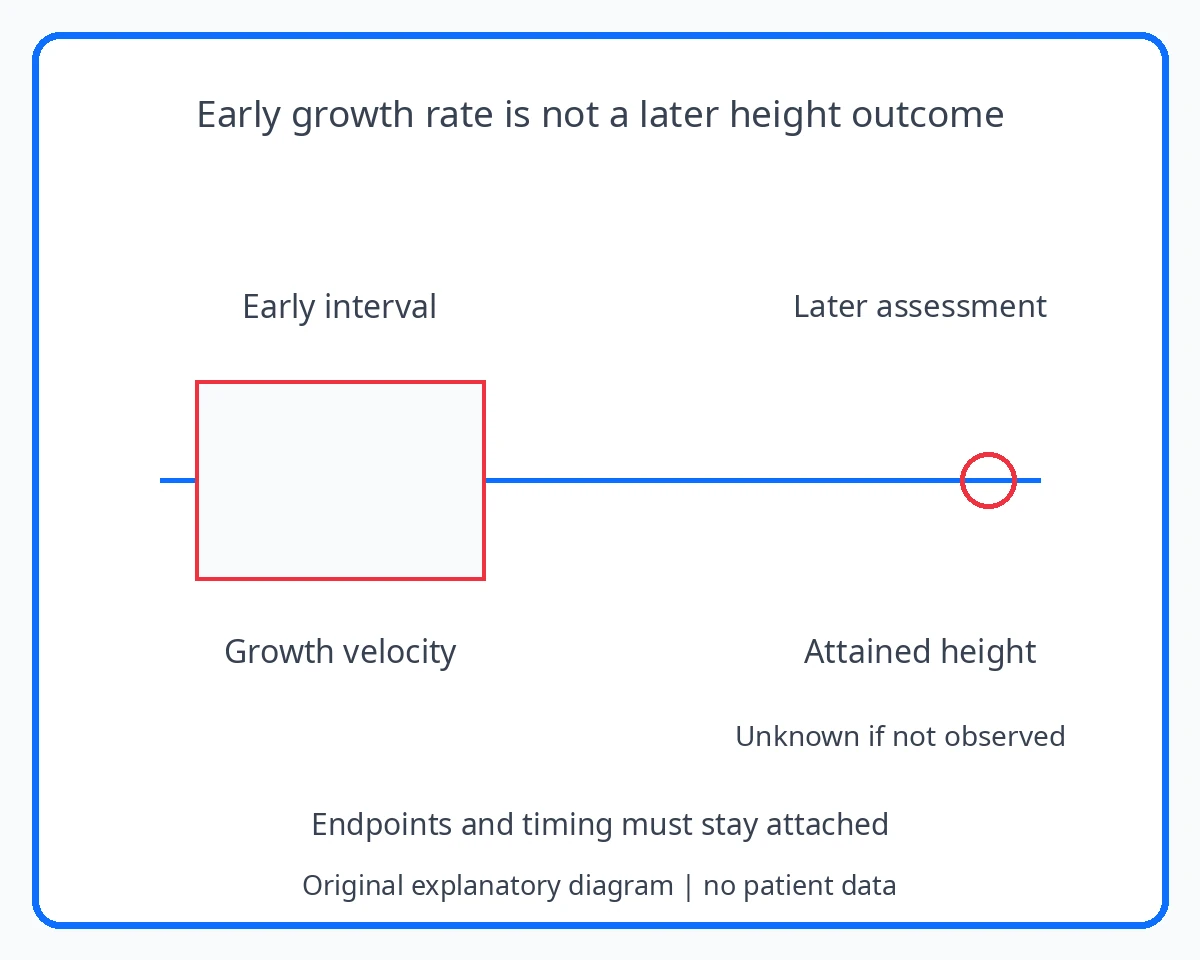
Identify whether the result is a rate or an attained height
Growth velocity expresses height change over time, commonly in centimetres per year. An attained-height outcome describes a later measured height, sometimes also expressed relative to a reference. The KIGS report separates growth outcomes and a defined near-adult-height analysis. Its categories show why the time point and outcome name belong beside each result.
A first-year rate summarizes that interval. It does not tell the reader how long the rate continues, how the later trajectory changes or when growth ends. A paper may report useful early evidence while leaving the later endpoint unanswered. The missing outcome should remain missing rather than be reconstructed through a straight-line projection. [1]
For the arithmetic role of measurement intervals, see Why the Interval Between Height Measurements Matters
For the clinical distinction between treatment goals and guaranteed height outcomes, see HGHThai’s overview of growth hormone treatment goals
Check who qualifies for the later endpoint
Near-adult height is a study-defined endpoint, not a label to attach whenever follow-up feels long. Find the paper’s eligibility rules and the number of participants who meet them. People with a later outcome may have different follow-up or other characteristics from everyone who entered the database. Keep that analysis group identifiable.
The KIGS report uses separate criteria for its analysis populations. Do not place the largest database count next to a later-height estimate unless that is genuinely its denominator. A result from participants with sufficient later data answers a question about that analyzed group; it is not automatically a result observed for every starter. [1]
An early result with no later outcome available
This fictional example explains how to read an outcome. It is not a result for a medicine or an expected result for a child.
| Item to compare | Example or information | What it means |
|---|---|---|
| Outcome reported | First-year growth velocity | A rate during the stated early interval |
| Later endpoint | No adult-height result in this fictional report | Not observed here; do not supply a forecast |
| Participants | Number analyzed for first-year velocity is stated | Does not establish a later-height denominator |
| Misleading extension | Multiply the first-year difference by future years | Assumes an unobserved continuing trajectory |
| Faithful summary | Report the early endpoint and missing later evidence | Keep the timing and limits in the same sentence |
A first-year result cannot supply years of missing follow-up
Imagine that a report gives a difference in first-year velocity but no later attained-height outcome. Multiplying that difference by every remaining year assumes that the same difference persists throughout a period the report has not observed. The calculation may be easy, but the assumption carries the claim.
A clearer summary states the first-year result on its own terms and says that the later endpoint is unavailable in that report. If another publication reports later height, check whether it follows the same people, uses a defined endpoint and accounts for who remained in the analysis.
Check how much follow-up the study actually provides in Short and Long Follow-Up: Reading Growth-Treatment Studies
Match the conclusion to the endpoint actually observed
Before quoting a headline, ask whether it names the outcome, time point and population. “Improved growth” can hide the distinction between an early rate, a change in SDS and a later measured height. Replace that broad phrase with the actual endpoint, keeping any comparator and uncertainty attached.
Different endpoints can complement each other without being interchangeable. Early follow-up can describe an initial trajectory, while later outcomes address a different part of the question. Neither a research endpoint nor a missing one supplies a treatment decision for an individual child. Use the distinction to read the evidence more accurately, not to make a personal prediction. If wellbeing is reported alongside height, check how the quality-of-life outcome was measured before combining the conclusions.
Endpoint interpretation is not a treatment decision
This guide supplies no expected growth rate, individual final-height prediction or advice to start, stop or change treatment.
Sources and reading context
- KIGS pediatric growth-hormone registry analysis — Methods pages 3-4; limitations14, funding15. Distinct cohorts and observational limitations; no causal safety proof