Short and Long Follow-Up: Reading Growth-Treatment Studies
“A two-year study” can describe several phases rather than two years of one unchanged comparison. Before summarizing the duration, draw the study timeline: who entered, which treatment conditions applied, what changed and when the outcome was analyzed. Calendar length alone does not tell you how much controlled evidence a claim has.
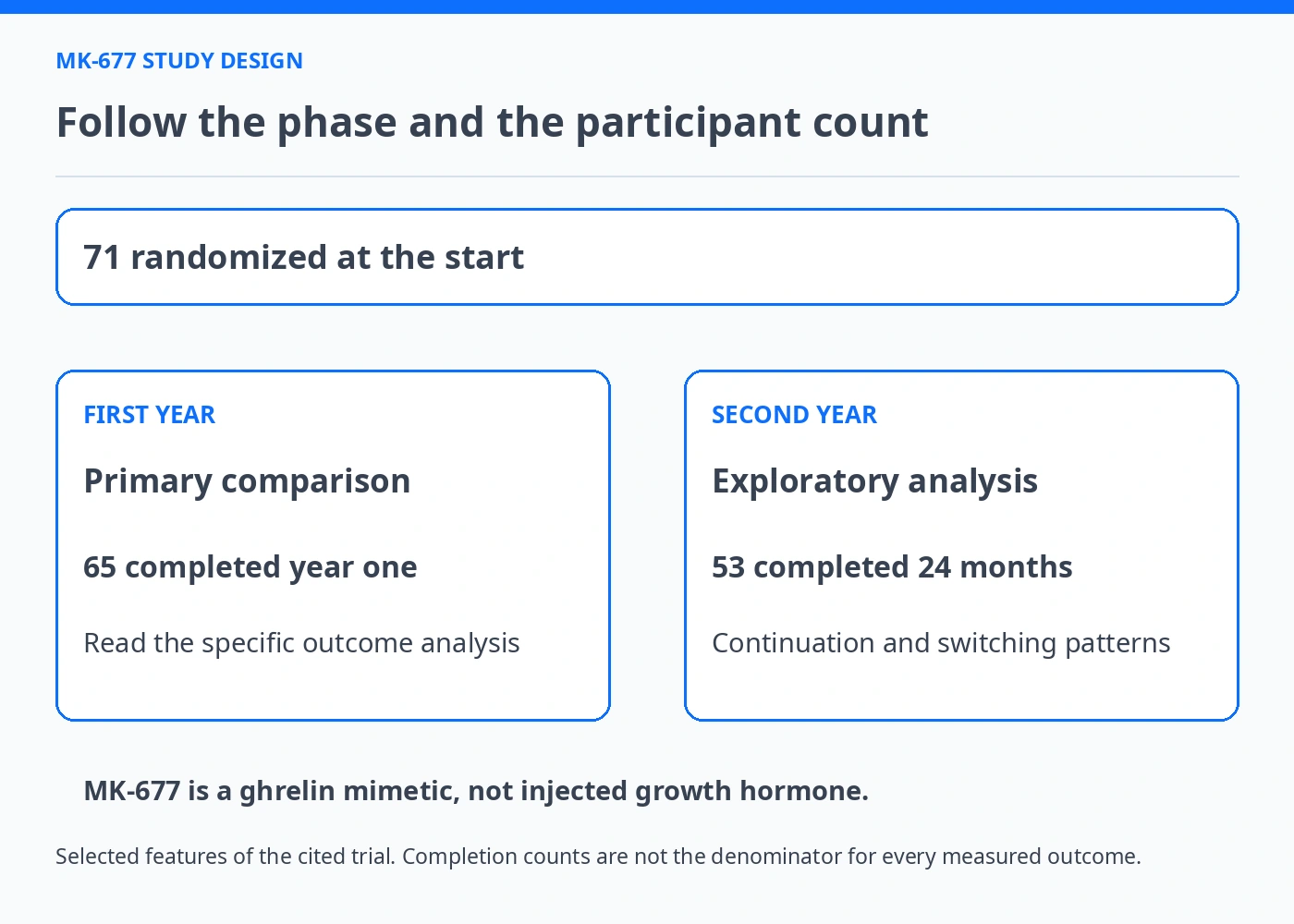
Read the design at each stage of follow-up
The MK-677 study in healthy older adults separates a first-year randomized primary analysis from an exploratory second year. MK-677 is a ghrelin mimetic, not injected growth hormone. The example is useful for reading study design because the later phase included continuation and switching patterns rather than simply repeating one unchanged comparison.
Describe the phases in the order the paper defines them. A primary time point, an extension and an exploratory analysis can all contribute information, but they do not automatically answer the same question. If the article headline mentions two years, look for the actual time point behind the quoted result instead of assigning the longest duration to every outcome. [1]
First check whether you are reading a protocol or a results report. A planned follow-up date describes what investigators intend to observe; it does not establish that participants completed that follow-up or that an outcome was demonstrated.
Check whether the study population matches the claim in Reading Anti-Aging Treatment Studies in Healthy Adults
Count people at the outcome, not just at enrollment
The MK-677 report describes 71 randomized participants, 65 completing the first year and 53 completing 24 months. These numbers describe different stages. They should not be treated as though the same number contributed every measurement or remained in the same condition throughout. A specific outcome table may require an additional denominator check.
Ask why participants left and how the analysis handled missing measurements. Cochrane’s interpretation guidance treats uncertainty and applicability as part of understanding the result. A later completer group may differ from the people originally enrolled; longer observation does not remove the need to inspect those differences and the study’s assumptions. [1] [2]
Reading the phases in the MK-677 report
This table summarizes selected design features of the cited study. It is not a complete participant-flow diagram or evidence about injected GH.
| Part of the question | What to retain | Why it matters |
|---|---|---|
| Enrollment | 71 participants randomized | Starting population, not every later outcome denominator |
| First year | Primary randomized comparison; 65 completed the year | Check the analysis and time point for the quoted result |
| Second year | Exploratory phase with continuation/switching patterns | The comparison structure changed |
| At 24 months | 53 participants completed | Completion count is not automatically a specific test’s sample size |
| Product identity | MK-677, a ghrelin mimetic | Do not relabel it as injected growth hormone |
Rewrite a duration claim around the actual endpoint
Suppose a summary says “two years proved benefit” while citing a result from the first-year primary analysis. That sentence attaches the longest calendar duration to the wrong comparison. A clearer account identifies the twelve-month result first, then describes what the exploratory second year examined.
The extension is not discarded. It is given its own design, participants and limits. This prevents later observations from lending unwarranted certainty to an earlier result, or an early result from being presented as evidence that a benefit persisted unchanged.
Keep the duration of the claim within the observed question
A short-term biomarker or body-composition result cannot directly establish lifetime benefit. Conversely, not demonstrating an outcome in a limited study is not proof that an effect is impossible in every population and setting. State the endpoint, comparison, follow-up and uncertainty together so the reader can see the boundary of the finding.
When transferring a finding to another claim, check the product and participants as carefully as the dates. Healthy older volunteers, patients with confirmed deficiency and children with growth concerns are not interchangeable populations. The timeline helps assess evidence; it does not provide a prescribing recommendation or a reason to substitute one hormone-related product for another.
For endpoints that need later follow-up, see Growth Rate and Adult Height: Different Outcomes in a Study
A longer calendar is not an unchanged experiment
The MK-677 example is not evidence that injected GH produces the same effects. No longevity, prescribing or treatment recommendation is made.
Sources and reading context
- MK-677 trial in healthy older adults — Ghrelin mimetic, not injected GH. Year1 randomized primary analysis; year2 exploratory. No demonstrated function benefit is not universal proof of absence
- Cochrane Handbook chapter 15: interpreting results — Interpretation and applicability; precision does not remove bias